Change a value under Editor in settings and it reaches the manuscript on the spot. There is nothing to save separately.

Font size and line height

Default Font Size under Typography is the size of one body paragraph. The default is 12pt and the list runs from 8pt to 72pt, but you can also type a number straight into the field. Decimals like 13.5 are accepted, and pt is appended for you. Headings follow it by a multiple. With the body at 12pt, a level 1 heading is 24pt and level 2 is 18pt. Line height is Default Line Height under Spacing. Nine steps from 1.0 to 3.0, with 1.5 as the default. It leaves paragraphs you gave a line height of their own alone, and reaches only paragraphs and headings with no setting of their own.
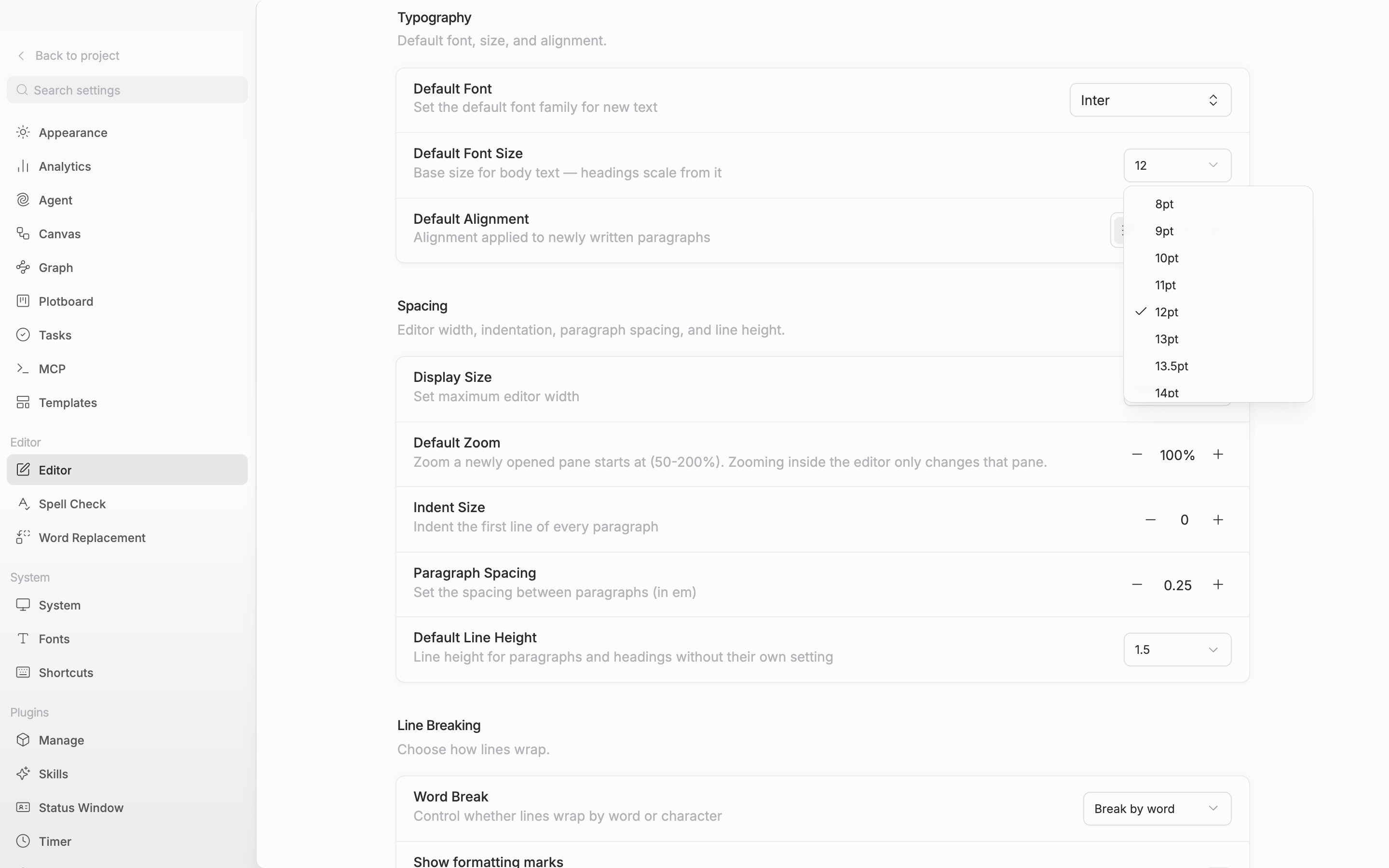
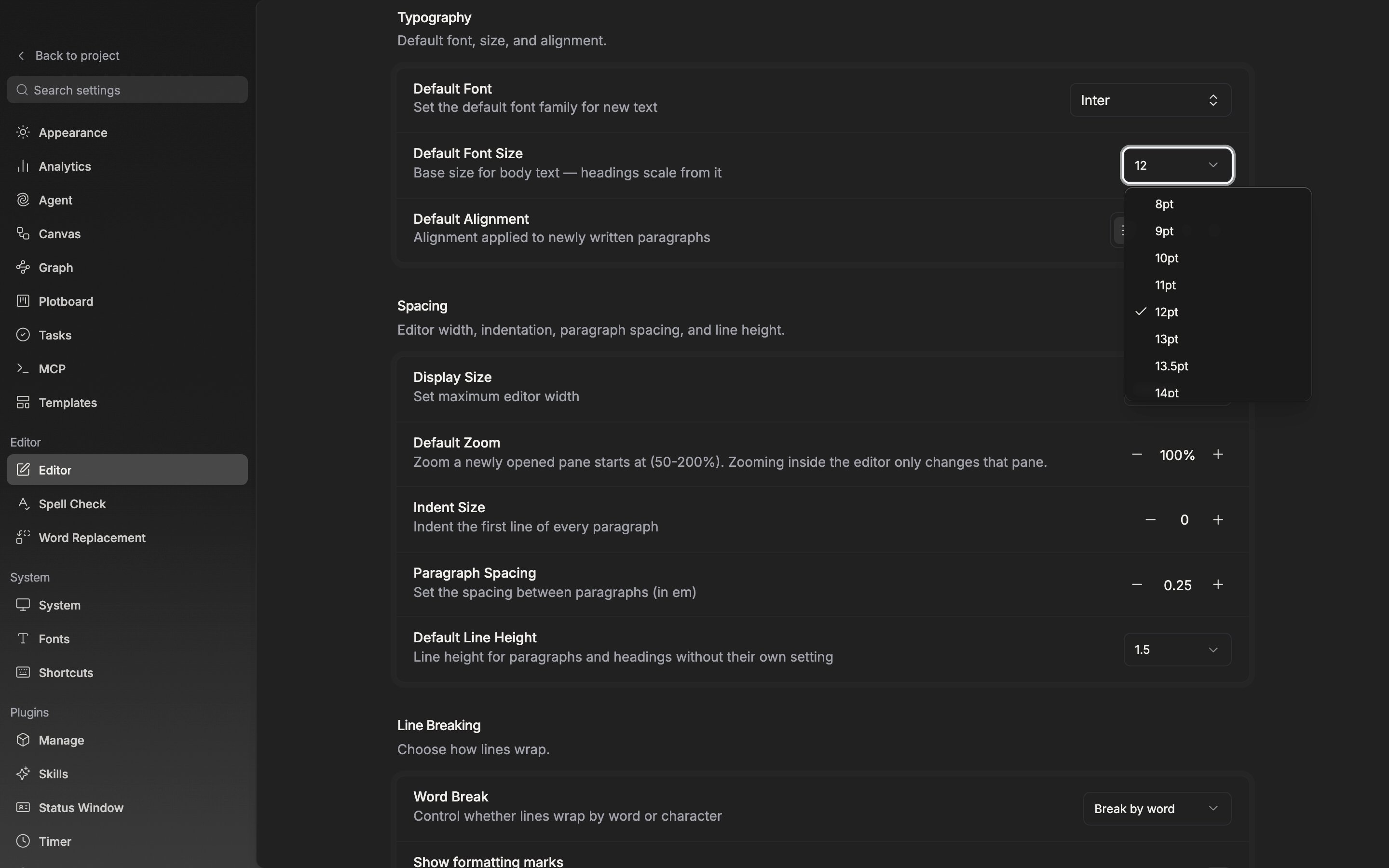
The Editor screen in settings. The Default Font Size dropdown in the Typography section is open, showing the 8pt–72pt list, with the Default Line Height row of the Spacing section visible below.

Set the body size and heading sizes follow it by a multiple.

Word break

Word Break under Line Breaking decides how a line wraps at the right edge. Break by word does not split a word; it drops the whole word to the next line. Break by character breaks per character, keeping the right edge straight. The default is by word.

Markdown, slash, and mentions

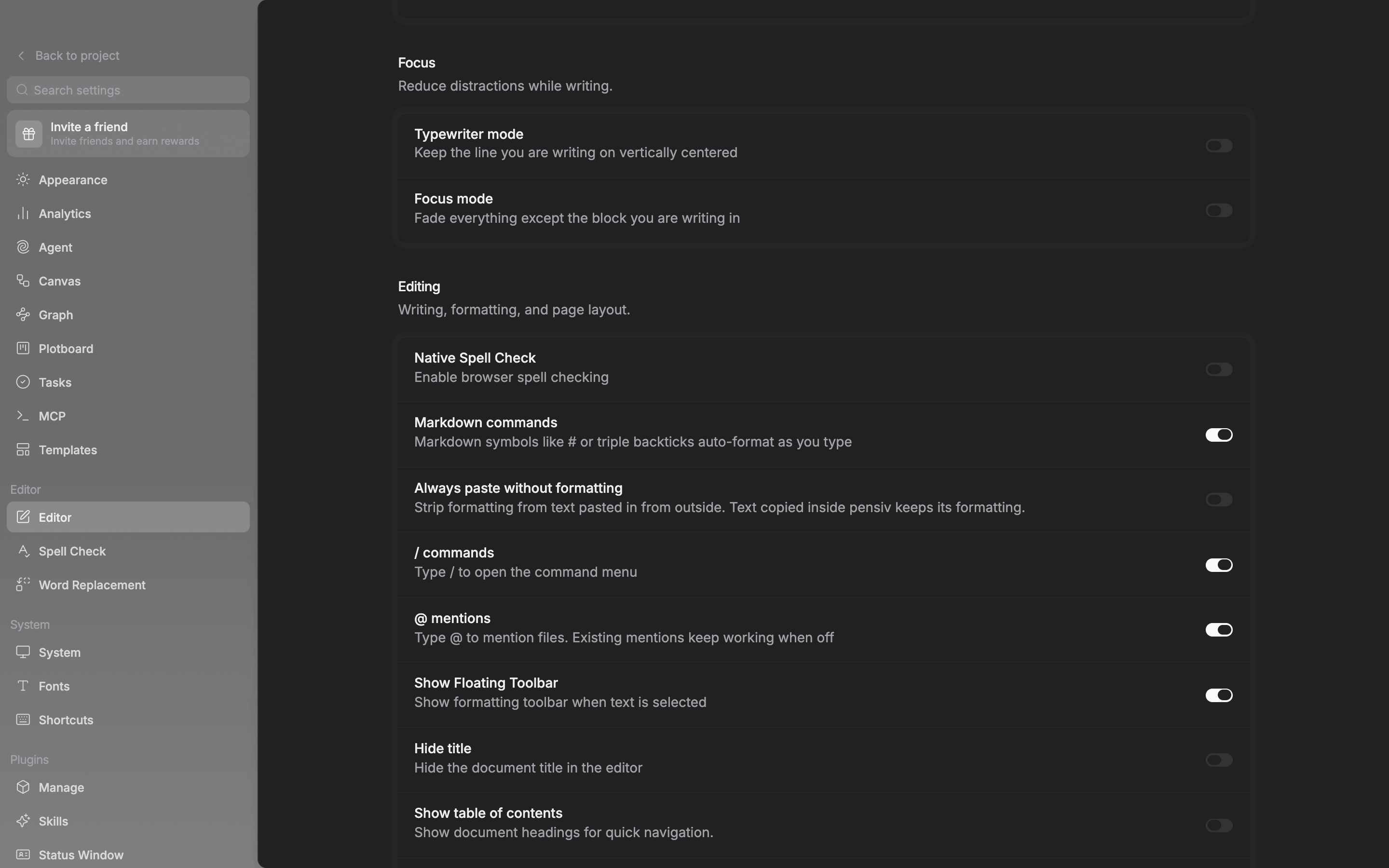
The three switches in the Editing section, Markdown commands, / commands, and @ mentions, all start on. Markdown commands turns symbols at the head of a line — # and a space, - and a space, --- — into formatting. Turn it off to keep symbols as symbols. * * *, used for a scene break, does not become a list even with it on. / commands brings up the formatting and insert menu, and @ mentions links documents, sheets, folders, plotboards, and canvases from the same project into the body. Turn mentions off and the mentions already placed can still be clicked through.
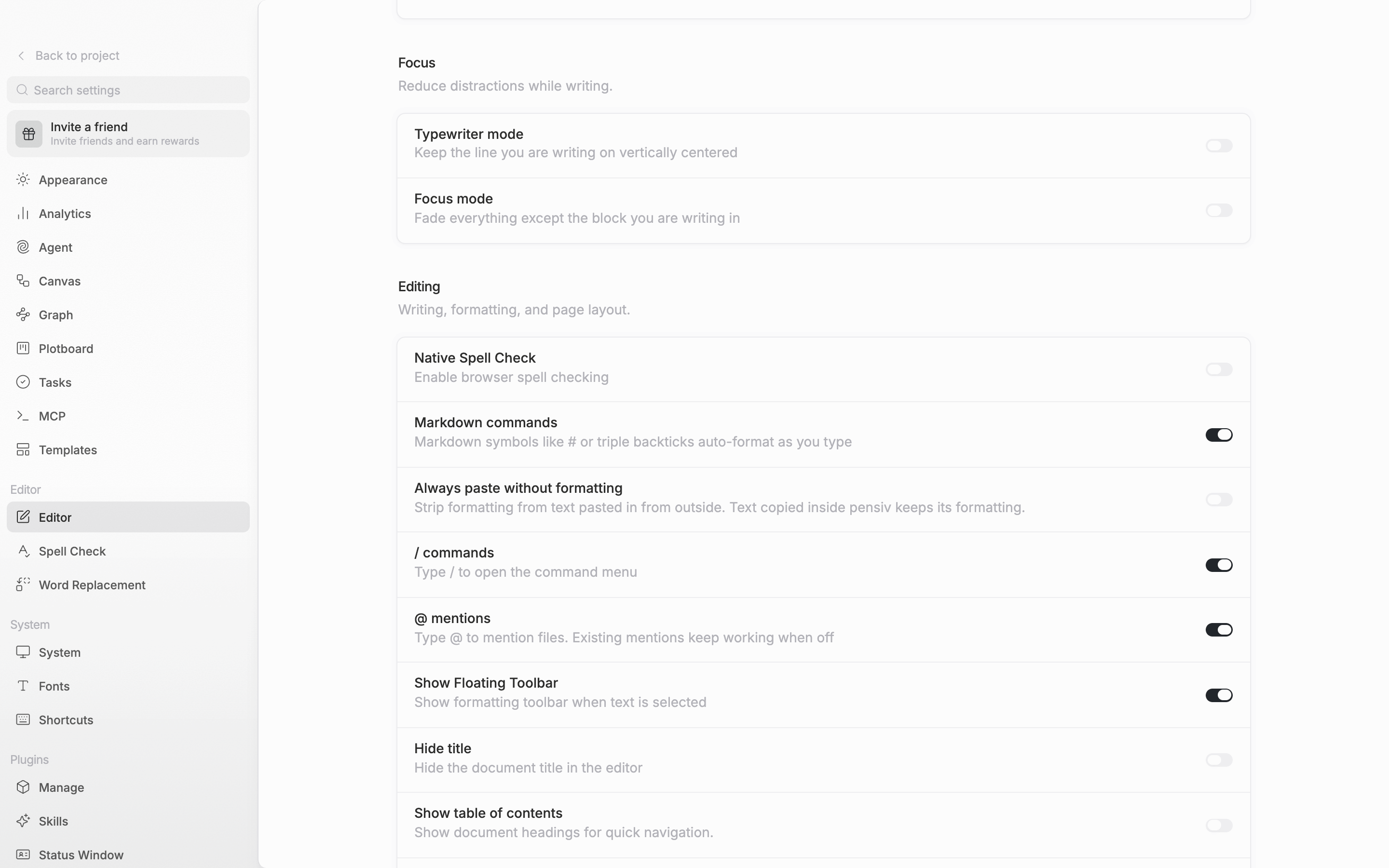
The Editing section in view. The Markdown commands, / commands, and @ mentions rows sit one after another and all switches are on.

The three input methods are turned off one by one.

Dropping formatting when you paste

Paste text from Word or a web page and its font, size, and even color come along with it. Normally you strip that off by pressing Paste without formatting on the “Pasted with formatting” notice, or by pasting with Cmd(Ctrl)+Shift+V from the start. If you often pull in reference material, turn on Always paste without formatting in the Editing section. Text brought in from outside then always comes in as plain paragraphs, and blank lines stay blank paragraphs. Text copied within pensiv keeps its formatting even with this on. It starts off.

Page view defaults

Lower down in the Editing section, Page view, Paper size, Orientation, Unit, Page margins, Pages per row, Show page numbers, and Show ruler are gathered together. These are the defaults newly opened documents follow. How to change them per document, and how to use the ruler and header, are covered in Page view and page setup.

How far each one follows

Font size, line height, and word break attach to the document, so people working with you see the same shape. The switches in the Editing section are settings that reach your hands alone, so other people’s screens stay as they were. The values here are defaults; where a particular document has a value changed on its own, that one wins in that document.